
Check out this very well-done interview with Jason V Brock by Henry Chamberlain over at Comics Grinder.


Check out this very well-done interview with Jason V Brock by Henry Chamberlain over at Comics Grinder.


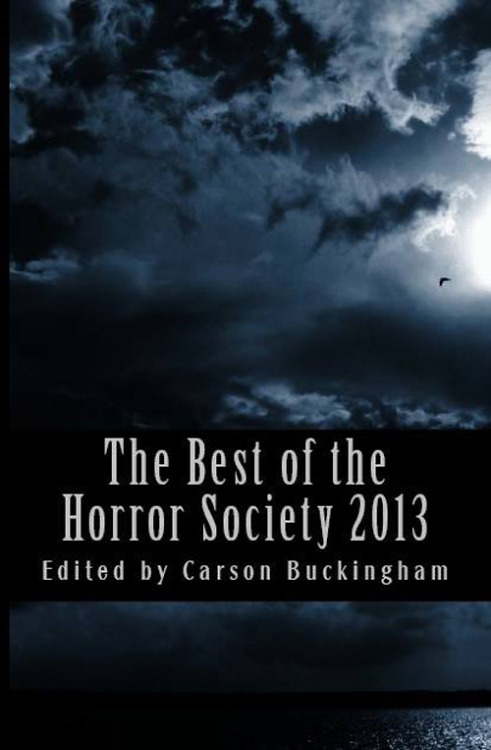
The Best of The Horror Society 2013, edited by Carson Buckingham, The Horror Society/CreateSpace Independent Publishing Platform, 2013. Info: createspace.com.
“A central coast trip that leads to devastating consequences for wine collectors. An adjoining hotel room that isn’t what it seems. A long bus trip with a stopover in an eerie little town. You’ll visit these places and more in this volume. Or how about the old woman with the strange plant? Or the odd little boy selling lemonade? Perhaps the sideshow lady who just smells so good? You’ll meet them all at the turn of a page and they will remain with you long after the book is closed. The Best of the Horror Society 2013 is an anthology of the weird, the wonderful, and the downright wicked. Within you will discover not only the best of emerging horror writers but seasoned pros whose names you will no doubt recognize as well. So turn out the lights, pull up a chair beside the nearest roaring fireplace and enjoy the ride.”
Contents:
FOREWORD – Scott M. Goriscak
INTRODUCTION – Carson Buckingham
CEREMONY – William F. Nolan
TENDRILS NEVER LIE – Kevin A. Ranson
THE MASK – Lisamarie Lamb
LEMMINAID – Carson Buckingham
THE CENTRAL COAST – Jason V. Brock
WHITE HELL, WISCONSIN – Weldon Burge
VICTIMIZED – Richard Thomas
NORMAL IS RELATIVE – Dan Dillard
THE PROCEDURE – Doug Lamoreux
THE LITTLE CHURCH OF SAFE CROSSING – Joe McKinney
MADELEINE – Julianne Snow
IT HAS TEETH – Christian A. Larsen
MASQUERADE – Dave Jeffery
BLACK BIRD – Rose Blackthorn
ADJOINING ROOMS – Scott M. Goriscak
THE INSPIRATION & HORROR OF GEORGE & HUGH – Nicholas Grabowsky
THE CLOWN – Henry Snider
MOVING DAY – Mark Onspaugh
ELLEN – Lee Pletzers
DADDY – Aaron Warwick Dries
SOFT LIKE HER – Charles Colyott
VENUS – L.L. Soares
THE LUMINOUS VEIL – Ian Rogers
BEER & WORMS – T.E. Grau
BLACK MARY – Mercedes M. Yardley
THE BOY IN THE ELEVATOR – Robert S. Wilson
WEIRD – Dean M. Drinkel
HOTTIES – Mort Castle
10:00 am |
Novembre 17 2013
| 1 nota

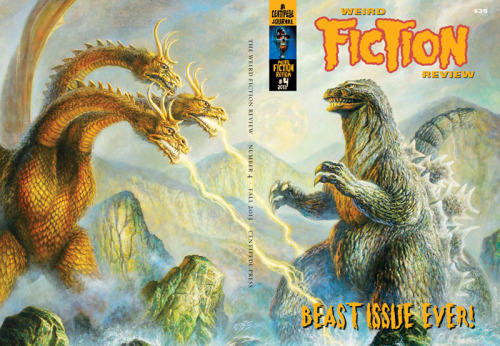
Weird Fiction Review #4, November 2013, edited by S.T. Joshi, Centipede Press, 2014. Cover art by Bob Eggleton, info and previews: centipedepress.com.
“The Weird Fiction Review is an annual periodical devoted to the study of weird and supernatural fiction. It is edited by S.T. Joshi. This fourth issue contains fiction, poetry, and reviews from leading writers and promising newcomers. It features original stories and essays by J. C. Hemphill, Donald Tyson, Mark Fuller Dillon, Ann K. Schwader, Michael Washburn, James Goho; a lengthy interview with Patrick McGrath; an 8-page full-color gallery of art by Bob Eggleton; regular columns by Danel Olson and John Pelan and much more.”
Contents:
Rare Breeds, Short fiction by J.C. Hemphill
Lunguistica Obscura, Short fiction by Lynne Jamneck
HPL and WHH: Ships in the Night, Essay by Sam Gafford
Stranger On a Bus, Short fiction by Donald Tyson
The Pukey, Classic short story by Nigel Dennis
The Twilight Zone: American Alien-Nation, Article by Christopher Cappelluti
The Vast Impatience of the Night, Fiction by Mark Fuller Dilon
Halsey and the Padre: A Fourteen-Year Old’s Perspective on Henry S. Whitehead, Article by David Goudsward
Wales and the Weird Tale, Article by Mark Howard Jones
Heh, Heh, It’s Jack Davis, A look at the classic E.C. Illustrator by John Butler
This Red Night, Fiction by Michael Kelly
The Tell-Tale Offal, Fiction by Clint Smith
The Haunted Wood: Algernon Blackwood’s Canadian Stories, Article by James Goho
Artist Portfolio, Eight pages of stunning full-color works by Bob Eggleton
The New Monster Magazines, Article by John Butler
Forrest J Ackerman: Fan Zero, Article by Jason V. Brock
An Offer You Can’t Refuse, Fiction by Michael Washburn
Dennis Etchison’s The Dark Country: After Bradbury, Article by Simon MacCulloch
Through Haunted Minds: An Interview with Patrick McGrath by Danel Olson
Casket Letters, The Gothic Year in Review by Daniel Olson
Forgotten Masters of thr Weird Tale, John Pelan talks about Edmund Snell
Notes on Contributors
Poetry:
Leigh Blackmore
Philip A. Ellis
Angelee Sailer Anderson
Charles Lovecraft
Ann K. Schwader
Sam Middleton
Fred Phillips
Wade German
8:00 am |
Febbraio 4 2014
| 3 note


William F. Nolan is perhaps best known for coauthoring the novel Logan’s Run with George Clayton Johnson, and has written hundreds of pieces, from poetry to nonfiction to prose. He also had a long career in the movie industry, and co-wrote the screenplay for the 1976 horror film Burnt Offerings which starred Karen Black and Bette Davis. Nolan has also been a prolific editor of collections (by others), and anthologies, frequently with Jason V. Brock. He has received the Living Legend in Dark Fantasy award by the International Horror Guild in 2002. In 2010, he received the Lifetime Achievement Stoker award from the Horror Writers Association (HWA).
Jason V Brock is an American author, artist, editor and director. He is the CEO and co-founder (with his wife, Sunni) of JaSunni Productions, LLC, whose documentary films include the controversial Charles Beaumont: The Short Life of Twilight Zone’s Magic Man, andThe AckerMonster Chronicles. His novella, Milton’s Children, was published by Bad Moon Books in early 2013. He has partnered with William F. Nolan as co-editor on several anthologies. They most recently worked together on Tales from William F. Nolan’s Dark Universe comic book adaptation of Nolan short stories. (Available from Bluewater Productions).
DARK UNIVERSE is meant to showcase graphic adaptations of stories contained within the DARK UNIVERSE omnibus, a collection of short works by author Nolan. Plans are to adapt these stories into six individual issues and then later collect them all in a trade paperback or hardcover edition. (Note: A review of the first three issues was featured on this site in February 2013. An updated review will appear on this site shortly. )
Further insights regarding the production of Tales from William F. Nolan’s Dark Universe were obtained during a recent conversation with the authors:

Why adapt Dark Universe for comics? Why not an audio presentation, such as a CD? Or a movie or TV series? Even a stage play?
Jason V Brock: It’s a natural, really. I mean, Bill’s (Nolan) stories are visual and have a lot of visceral impact, so when we put the original deal together with Bluewater for Logan’s Run: Last Day and the subsequent Logan comics, we asked for a mini-series of the horror titles. Plus, once they come out as comics, then the plan is to collect them together in a graphic novel format with an introduction from the two of us. Should be quite a package—
William F. Nolan: Exactly. Darren (Darren G. Davis, publisher) at Bluewater was working on a Vincent Price series at one time as well, so it was a logical extension of that idea. I’ve always liked adaptations of my work into comics, which has happened on other occasions, so when we got this going, I asked to adapt half, and wanted Jason to adapt the rest. We did six stories apiece, so twelve total. They turned out well, I think…
Strangely enough, I did have an audio version of several of my stories done by an outfit in San Francisco. We recorded them with sound effects, actors, and full introductions read by me. It never materialized, unfortunately.
Brock: Yes, it’s too bad. I was with you during the recording of the intros. They were to be streaming on the web, then CDs later.
Nolan: Right. An anthology movie would never work, for the same reason an anthology TV show wouldn’t – no one seems interested in that format these days. Now a stage play is an interesting idea. I wrote one about Dashiell Hammett called Dash that’s been performed a few times.
Whose idea was it to do a comic book version of select stories?
Nolan: Mine, as I recall.
Brock: That’s correct.
How hard is it to adapt? Are certain stories selected because of ease of adaptation? Or, other criteria? Are there some stories that you would like to adapt to comics that aren’t possible because of content or difficulty to translate to a visual medium?
Brock: Adapting stories is harder in some ways, and, like film or TV adaptations, sometimes one has to alter the original story to achieve what the visual medium of comics requires—

Nolan: That’s right. People never understand that about movies or television. Sometimes you have to rewrite or rework things, combine elements, drop things, and so on. Doing a straight “literal” adaptation almost never works. The only exception I can think of is The Maltese Falcon. It was a near verbatim copy of the book, but that’s another story…
We each chose the stories we wanted to do; I adapted the stories of mine that I felt had the best characters (‘The Halloween Man’, ‘Major Prevue Here Tonite’, ‘Heart’s Blood’, ‘Ceremony’, ‘Starblood’, and ‘The Partnership’). They are some of my favorites in the collection (Nolan’s Stealth Press horror omnibus Dark Universe). Jason really did a great job, though! The stories he picked were very hard to adapt, I think. I know I couldn’t have done them! And he pulled it off beautifully, I might add.
Brock: Much appreciated. It was fun. As you say, I had to change a few things to make them work, but they came together well… My main criteria were I wanted to do something memorable, something that doesn’t normally get adapted. Plus, we wanted to avoid things that others had adapted previously, too.
(Brock adapted the following stories: ‘The Pool’, ‘Vympyre’, ‘Him, Her, Them’, ‘The Giant Man’, ‘Boyfren’, and ‘A Real Nice Guy’.)
Is there a new revised print edition of Dark Universe the anthology coming to market?
Brock: Actually, yes, that’s in the works. I am the editor on Bill’s upcoming new collection, which was originally to be published by Arkham House, but which fell through with their apparent dissolution. Too bad, as it would have been an interesting fit for them, and is pretty much completed. I was able to garner interest for it from the fantastic Centipede Press, however, and I believe it should be out in time for the World Fantasy Convention in Brighton, England later this year, which we will all be attending. It’s called Like a Dead Man Walking and Other Shadow Tales, and will feature about 90% new, unpublished material, with a few classic reprints to round it out. Later, Jerad (the publisher) is planning on a huge, current Best Of William F. Nolan that I convinced him was a good follow-up to this, and that will be, I believe, a part of his Masters of the Weird Tale series. It will have science fiction and horror, as well as some literary works and poetry.
How are the artists selected for the stories?
Brock: Darren G. Davis (the president of Bluewater) handles all of that—
Nolan: We do get some say over the type of art, but he does the artist selection, as Jason pointed out. I love the art in the Tales from William F. Nolan’s Dark Universe series, and really liked the art in most of the Logan series, especially the first four issues.
How much of the comic layout and panel art is determined before assigning to the artist?
Nolan: Well I write the scripts for the comics as a sort of screenplay format, with basic scene setting, character description and so on, but I use all the dialogue from the stories, and the plots. Jason works a little differently, I know…
Brock: True—I prefer to write very detailed scripts, and break down each scene into panels with a lot of specifics for the artist. I had to do that, as a few of the ones I adapted were quite short, and these had to carry over half of a twenty-two page comic. Of course, I use the setting, plot, and dialogue (mostly) from the stories…
How much does the artist contribute?
Brock: For me, not a tremendous amount in terms of characterization and paneling; in terms of artwork and the “look,” a great deal…
How easy or hard is it to translate these stories to an illustrated medium?
Nolan: I grew up on comics, and I used to write comics with my departed pal Charles Beaumont (The Twilight Zone), but they weren’t horror titles. I like adapting works into other mediums, so it’s fairly simple for me—
Brock: Well, it depends a great deal on the tale that you’re adapting, I think. Some are easy and others are more difficult.
Are there any benefits to a comics version of these stories? More impact? Able to tell a story in less pages because of the visual/text capabilities?
Brock: I think it’s a great way to introduce younger readers to new stories. The challenge was to expand rather than condense, as Bill has a spare writing style, so I really had to wring more from the story without resorting to a padded feel.
Nolan: I agree with Jason. Young people love the visual impact, so it gets them to read more, and if they like these, then maybe they’ll check out the books we do.
Compare this work to your work on the Logan’s Run comic. Was it easier or more difficult to adapt, Dark Universe or Logan’s Run?
Nolan: We didn’t actually adapt any of the Logan series—

Brock: That’s true, though I have done a one-shot based in that world called Logan’s Run: Solo. It’s an original piece, however, and not an adaptation. The story is about a very far-future Logan and what happens to him as an aged Runner. On Logan’s Run: Last Day we were consultants, and did the costume designs and plotting of the story over the first six issue arc, then Paul J. Salamoff wrote it.
Nolan: I have to say that I’ve read Logan’s Run: Solo and thought it was just fantastic. Ingenious what Jason did with the character and the scenario. It’s going to be an aspect of the upcoming book we’re planning to co-write in the Logan universe called Logan Falls, which will turn the franchise upside down—
Brock: Well, I hope it does… It will also incorporate, like Logan’s Run: Solo, the pieces from the Bluewater Logan’s Run: Last Day series called ‘Future History’, which I created but was not credited with. I’m reclaiming all of that back-story, as it was mine anyway, and both of us felt was one of the more interesting aspects of the series. It was a way of modernizing the older elements of the Logan saga; I want to deconstruct the “Logan mythos” and do more with the characters.
Would you like to work in comics again? On what sort of project? Do you have any plans to do so?
Nolan: Of course. I love comics!
Brock: Yes. I enjoy the medium a lot. We are doing a couple of things currently, but can’t discuss them yet.
What else are you presently working on?
Nolan: I’m always working on about eight or ten books at any one time… Jason mentioned a few of them. Hippocampus Press is doing a collection of my writings about Ray Bradbury which is due out very soon called Nolan on Bradbury; it’s edited by S. T. Joshi, and has pieces from Ray, Jason, S. T., and Greg Bear as well… And of course waiting on the Logan’s Run re-make!
Brock: Well, we just dropped our documentary on Forrest J Ackerman (The AckerMonster Chronicles!) to rave reviews, so Sunni (my wife and film editor) and I are promoting that. As I said, Bill, Sunni, and I will be at several cons throughout 2013, from World Fantasy to World Horror, to Norwescon, and OryCon… Then I just had my standalone novella, Milton’s Children, come out from Bad Moon Books. Hippocampus Press is also releasing my first short story collection, Simulacrum and Other Possible Realities soon, and I’m still working on NAMELESS which is a biannual digest… You can grab that in PDF and print format. The work doesn’t end!
NEXT: A REVIEW OF ALL ISSUES PUBLISHED TO DATE OF WILLIAM F. NOLAN’S TALES FROM THE DARK UNIVERSE.
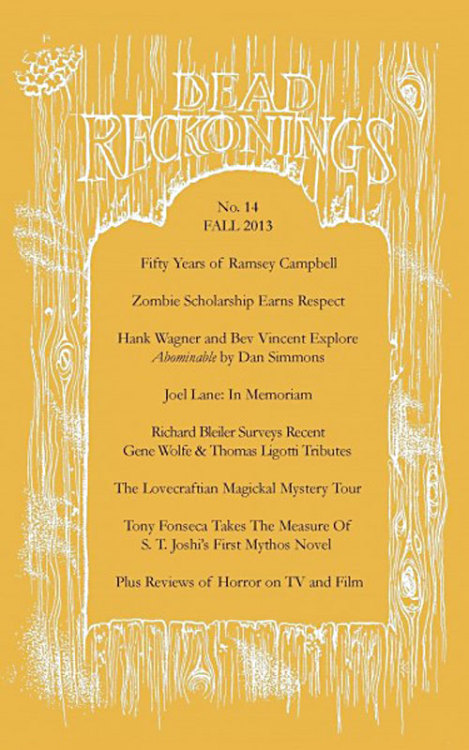
Dead Reckonings No. 14, edited by June M. Pulliam and Tony Fonseca, Hippocampus Press, 2014. Info: hippocampuspress.com.
“A Review of Horror Literature.”
Wagner and Vincent on Simmons – Hank Wagner and Bev Vincent (Dan Simmons, The Abominable)
Ramsey Campbell, Probably: The Grin Beneath the Flesh
From Horror to Homage – Richard Bleiler (J. E. Mooney and Bill Fawcett, eds., Shadows of the New Sun: Stories in Honor of Gene Wolfe; Joseph S. Pulver, Sr., ed. The Grimscribe’s Puppets)
Joel Lane: In Memoriam – Robert Butterfield
Other Realities—Alternate Readings: Two Views on Jason V Brock (Jason V Brock, Simulacrum and Other Possible Realities)
Outlier – Jonathan Johnson
Brock as Intriguing New Voice – Darrell Schweitzer
Malignant Mothers – Richard Bleiler (John Boyne, This House Is Haunted, Sophie Hannah, The Orphan Choir)
What Happens After – Sarah Simms (Ellen Datlow and Terri Windling, eds., After: Nineteen Stories of Apocalypse and Dystopia)
571 Forrester Lane Eats Babies – Matthew McEver (Sonja Condit, Starter House)
Triskaidekaphilia – Jonathan Johnson (Jonathan Thomas, Thirteen Conjurations)
Submitted: My Stamp of Approval – Tony Fonseca (Reba Wissner, A Dimension of Sound: The Music of The Twilight Zone)
Religious Fanaticism Run Amok – Antoinette Winstead (L. Andrew Cooper, Burning the Middle Ground)
Fifty Years of Ramsey Campbell – S. T. Joshi (Ramsey Campbell, Holes for Faces; The Kind Folk; and The Last Revelation of Gla’aki)
Two Veteran Storytellers Demonstrate How It Is Done – Robert Butterfield (Darrell Schweitzer, The Emperor of the Ancient Word; Tony Richards, The Universal and Other Terrors)
Zombie Scholarship Earns Respect – June Pulliam (Jennifer Rutherford, Zombies; Aalya Ahmad and Sean Moreland, eds. Fear and Learning: Essays on the Pedagogy of Horror)
Sequel Deserves to be a Forgotten Chapter – Braden Dauzat (James Wan, dir. Insidious: Chapter 2)
Haunted from Within and Without – Richard Bleiler (Ellen Datlow, ed. Hauntings)
A Darker Piece of Darkness – John Edgar Browning (Ellen Datlow, ed. The Best Horror of the Year, Volume 5 and Blood and Other Cravings; Laird Barron, The Beautiful Thing That Awaits Us All and Other Stories)
The Lovecraftian Magickal Mystery Tour – Leigh Blackmore (Peter Levenda, The Dark Lord: H. P. Lovecraft, Kenneth Grant and the Typhonian Tradition in Magic)
A Smorgasbord of Weird – S. T. Joshi (Lois H. Gresh, ed. Dark Fusions: Where Monsters Lurk!)
Portrait of the Mythos-Maker as a Young Man – Tony Fonseca (S. T. Joshi, The Assaults of Chaos: A Novel about H. P. Lovecraft)
Second Time’s the Charm – Leigh Blackmore (H. P. Lovecraft, The Ancient Track: The Complete Poetical Works)
Covens, Witchcraft, and Murder, Oh My! – Antoinette Winstead (Debbie Viguie, The Thirteenth Sacrifice: A Witch Hunt Novel)
Zombies Are People Too – June Pulliam (Jonny Campbell, dir., In the Flesh)
The Weird Scholar – S. T. Joshi
Notes on Contributors
8:00 am |
Febbraio 15 2014
| 1 nota
